Why Now
Over the past few years, we’ve all watched artificial intelligence move from novelty to necessity.
For large carriers, that transition came with dedicated data science teams, big budgets, and the freedom to experiment. But for many regional and mid-sized carriers, the idea of AI has lingered just out of reach—exciting in theory, but hard to see as practical or affordable in daily operations.
That gap is closing fast.
The same breakthroughs that once required complex integrations and costly pilots are now available in simple, ready-to-use form. AI has evolved from something you build to something you apply—and that evolution has opened the door for every carrier to benefit from automation, not just those with enterprise budgets.
The Myth of Unreachable AI
I’ve spoken with many carriers who view AI implementation as an all-or-nothing decision. They imagine large-scale projects that demand months of IT time, heavy retraining, and budget cycles that push innovation years into the future. It’s understandable. For a long time, that perception was true.
But the technology has matured.
What used to require bespoke development now exists as modular, explainable, plug-and-play intelligence. The trial and error has already been done by the Tier-1 carriers who adopted it first. Those lessons are built into the systems available today—systems that start delivering results from day one.
At NeuralMetrics, we call this achievable AI. It means automation that fits your organization as it is, not as you wish it could be. It’s practical, predictable, and proven.
From Promise to Practice
Let’s take underwriting as an example.
In many carriers, underwriting still starts with incomplete data—a business name, maybe an address, and the hope that everything aligns with appetite. Underwriters spend hours chasing details, verifying operations, or trying to determine whether a small discrepancy changes eligibility.
That’s where achievable AI changes the story.
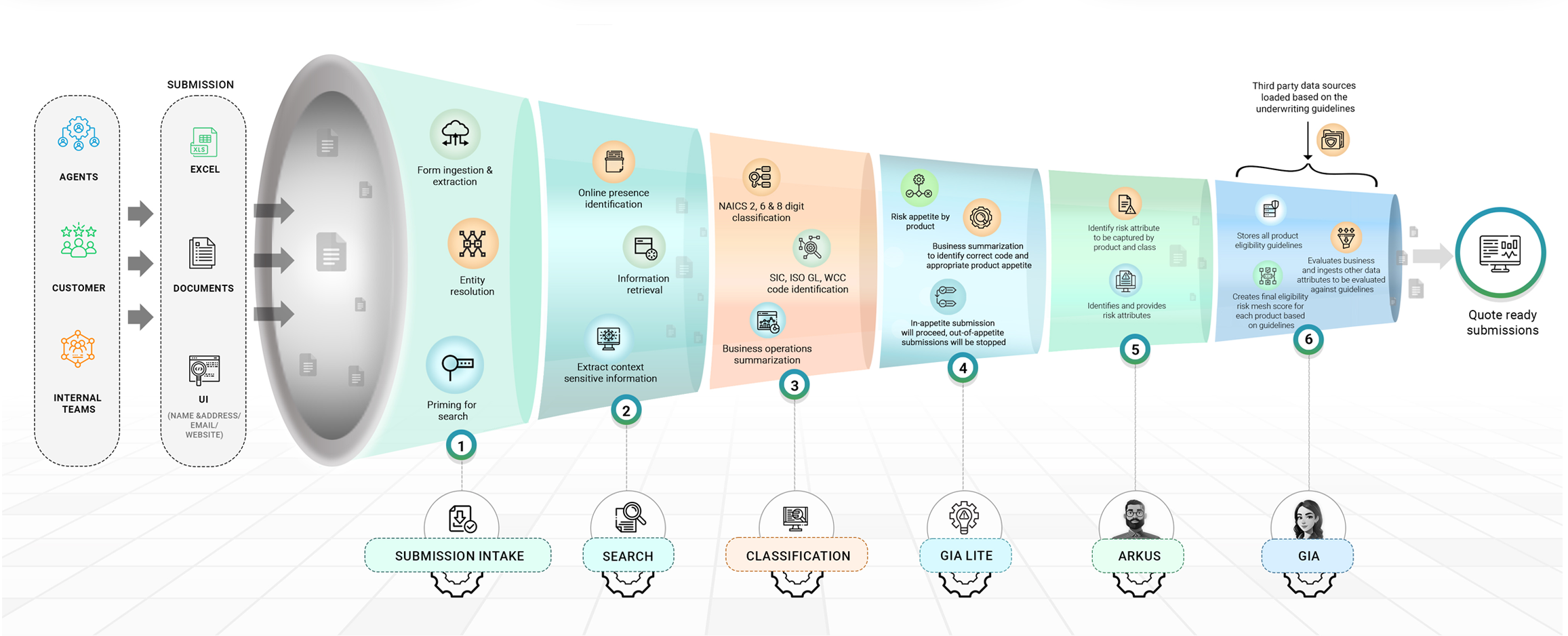
With modern, explainable intelligence, an underwriter can instantly understand the nature of a business from as little as a name and address. The system classifies operations, surfaces relevant risk factors, and aligns them with carrier-specific appetite rules—all in seconds.
It doesn’t replace the underwriter’s judgment; it amplifies it. The result is faster decisions, fewer touchpoints, and higher confidence in every quote.
We’ve seen regional carriers reduce intake times by over 50% simply by replacing manual data verification with transparent automation. The same technology that once took months to deploy for large carriers is now accessible to any organization ready to act.
Explainability Matters
Of course, automation alone isn’t enough. Trust matters most.
In regulated industries like insurance, every decision must be explainable—to regulators, to customers, and to the teams making them. Achievable AI meets that standard by showing its work.
When the system classifies a business, it reveals the reasoning behind it: the signals considered, the context applied, and the risk attributes detected. There are no black boxes—just clarity.
That transparency does more than satisfy compliance. It creates alignment.
When underwriters, agents, and customers can see how a conclusion was reached, trust follows naturally. It also reduces the time and friction spent reconciling discrepancies later in the process, because everyone starts from the same source of truth.
Explainability isn’t a technical feature; it’s an ethical one. It ensures that AI supports human expertise instead of obscuring it. And for carriers of any size, that’s the kind of foundation worth building on.
Path to Adoption
The best way to start isn’t with a full-scale transformation. It’s with one achievable step.
- Pick one workflow.
Begin where data friction is highest—underwriting intake, appetite alignment, or document ingestion. - Measure impact quickly.
Track turnaround time, submission quality, and underwriter satisfaction. - Scale with confidence.
Expand incrementally into other processes once results are proven.
Because today’s AI systems connect via standard APIs and secure cloud integration, there’s no need for custom development or specialized modeling. Carriers can deploy intelligence in a matter of weeks—not months or years.
What I find most encouraging is how many regional carriers are beginning to use AI not just to catch up, but to leap ahead. They’re able to adapt faster, update appetite logic in real time, and deliver the kind of transparency that customers increasingly expect from digital experiences.
In other words, AI is no longer a size game. It’s a readiness game.
The Future of Fair Intelligence
For decades, the conversation around automation has focused on efficiency and scale. But the next chapter is about fairness and accessibility—making sure the advantages of AI reach everyone in the ecosystem, not just the largest players.
That’s what achievable AI represents. It’s not a compromise; it’s a leveler.
It ensures that every underwriter, no matter the size of their company, has access to the same clarity, precision, and speed once reserved for enterprise-scale operations.
As someone who has spent my career bridging technology and human expertise, I believe the real story of AI in insurance isn’t about replacing people—it’s about empowering them.
The underwriter who understands a risk more deeply.
The small carrier that wins business faster because it can quote with confidence.
The policyholder who finally sees how pricing decisions are made.
That’s what progress looks like.
And it’s already within reach.
Achievable AI isn’t the future—it’s what’s possible right now.